And remember when Ibrâhîm (Abraham) and his son Ismâ‘îl (Ishmael) were raising the foundations of the House (the Ka‘bah in Makkah), saying: “Our Lord! Accept this service from us. Verily! You are the All-Hearer, the All-Knower.” Our Lord! And make us submissive unto You and of our offspring a nation submissive unto You, and show us our Manâsik (all the ceremonies of pilgrimage — Hajj and ‘Umrah), and accept our repentance. Truly, You are the One Who accepts repentance, the Most Merciful. — Qur’an 2[Al-Baqarah]:127–128
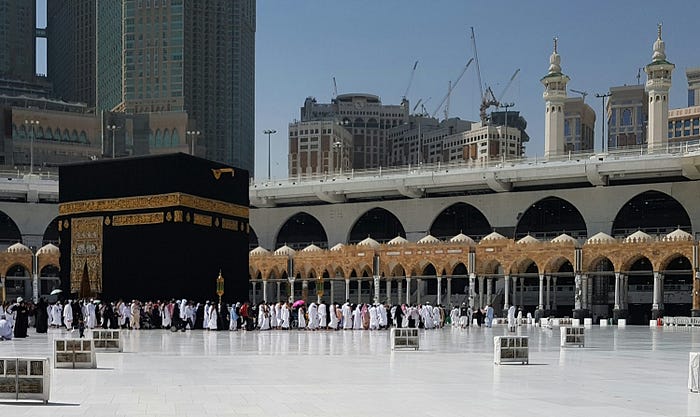
The first time I had the opportunity to set my eyes on the Kaabah, I was mesmerized. The feeling was so different that I didn’t know whether to cry or smile. I was grateful that Allah granted me the opportunity to answer the call and visit His house. After completing Umrah, there was really nothing much left to do than praying the salawaat in masjid al-haraam and doing voluntary tawaaf. It was during this period that some thoughts came to me: I asked myself why we even circumambulate this black box?
I first sought refuge with Allah, thinking it was an evil whisper from Shaytan. Then I told myself, it’s submission. The willingness to revolve our entire life around the commands of Allah, just as the Prophet Ibrahim did several times throughout his life. After that, a striking reminder came to my mind about the story of Umar and the Black Stone, which settled my heart:
Imam Al-Bukhārī reports that ʿUmar — may Allāh be pleased with him — came to the Black Stone while performing ṭawaaf, kissed it, and said, “I know that you are a stone, you do not cause benefit or harm; and if it were not that I had seen Allāh’s Messenger — peace and blessings of Allāh be upon him — kiss you, I would never have kissed you.”
A few weeks ago, I got a similar question after engaging in an Islamic reminder session. A member from the audience asked about the origin of the black stone and why we have to kiss it. I gave the response above, and that event sparked the thought to compile an article like this for the benefit of others who might have similar thoughts as well. In addition, it’s the season of Hajj, and there’s no better time to talk about this than now.
Hajj is a Journey of Faith and Legacy
Long before the advent of Islam, Mecca was a barren desert. According to Islamic tradition, it was to this uninhabited land that Prophet Ibrahim was commanded by Allah to bring his wife Hajar and infant son Isma’il. With no food, water, or shelter, it seemed like a harsh, even impossible command. Prophet Ibrahim, being a truthful servant, obeyed Allah’s injunction and moved his family. This migration was the beginning of a journey towards faith and a lasting legacy that has stood the test of time.
And mention in the Book ˹O Prophet, the story of˺ Abraham. He was surely a man of truth and a prophet. — Qur’an 19[Maryam]:41
Every year, millions of Muslims travel to Mecca to perform Hajj, a pilgrimage that stands as one of the Five Pillars of Islam. To the untrained eye, the rites of Hajj may seem like symbolic movements. But for Muslims, they are a reenactment of sacred history. This is a walking embodiment of profound faith, most notably by Prophet Ibrahim and his family. A man whose unwavering submission to the will of Allah serves as a spiritual archetype for Muslims.
His life, trials, leaving his homeland, rejecting idolatry, and enduring intense personal sacrifices, all for the sake of divine truth. One of the most significant chapters in Ibrahim’s story unfolds in the barren valley of Mecca. It is here that Allah commanded him to leave his wife Hajar and infant son Isma’il in the desolate wilderness — an act that would lay the foundation for one of Islam’s holiest sites.
The Kaabah is a House Built for Allah
Years later, Ibrahim returned to Mecca by divine command and, together with his son Isma’il, erected the Kaabah. This is the black cube-shaped structure that Muslims today face in prayer. Allah gives us a narration of this ordeal in the Qur’an:
And remember when Ibrâhîm (Abraham) and his son Ismâ‘îl (Ishmael) were raising the foundations of the House — the Ka‘bah at Makkah, saying: “Our Lord! Accept this service from us. Verily! You are the All-Hearer, the All-Knower.” — Qur’an 2[Al-Baqarah]:127
The Kaabah became the first house of worship dedicated to Allah Alone. It was not only the construction that was significant. The obedience, humility, and intention behind it were also relevant. This very Kaabah is the focal point of Hajj and the reason why Muslims circumambulate during Tawaaf.
The ritual of Tawaaf is deeply symbolic. It is the act of walking seven times around the Kaabah in a counterclockwise direction. It represents the unity of the believers in the worship of Allah, all moving in harmony around a central point. I recalled learning that the Earth revolves around the sun in an anticlockwise pattern in my Geography class. In the same way, the moon takes a similar motion around the Earth. Just as celestial bodies orbit in this pattern, so too do the hearts of believers orbit the spiritual center of Islam.
Get Dhun Nurayn El Shabazz’s stories in your inbox
Join Medium for free to get updates from this writer.
Use temp mail
Remember me for faster sign in
I have heard non-Muslims lay claim that our act of Tawaaf is similar to an idolatrous practice by us worshipping the black cube. However, Muslims circumambulating the Kaabah is not idol worship as some might mistakenly think. Rather, it is a physical expression of devotion. We do not worship the Kaabah; we worship Allah, the Lord of the Kaabah and all that exists. The Kaabah simply serves as a unifying direction for prayer, which we call Qiblah, and also serves as a historical anchor of faith.
The Other Rites of Hajj
The rites of Hajj serve as a living memory for anyone fortunate to attend. Many other rites of Hajj mirror events in the lives of Ibrahim, Hajar, and Isma’il. These include:
- Entering the Ihram: This is the white piece of cloth that Muslim men wear while making the intention to start the rituals of Hajj or Umrah.
- The act of Sa’i: Walking between the hills of Safa and Marwah reenacts Hajar’s desperate search for water. Her faith and persistence were rewarded with the miraculous spring of Zamzam.
- The Wukuf — standing at Arafat: This symbolizes the pinnacle of the Hajj and reminds pilgrims of the Day of Judgment. Prophet Muhammad ﷺ stood there and gave his final sermon, echoing the teachings of Ibrahim.
- The Stoning of the Pillars: This represents Prophet Ibrahim’s rejection of Shyatan, who tried to dissuade him from fulfilling Allah’s command. The pilgrims symbolically cast stones at these pillars to reaffirm their resistance to evil.
- The Sacrifice of Udhiyyah: On Eid al-Adha, Muslims around the world sacrifice an animal in remembrance of Ibrahim’s willingness to sacrifice his son, and Allah’s mercy in replacing the son with a ram.
Hajj is a Pilgrimage of the Soul
Hajj is more than a religious duty; it is a transformative personal journey of the soul. Every ritual echoes a timeless message: submission, sacrifice, and steadfastness. The rites of Hajj invite every Muslim to walk in the footsteps of Ibrahim — not just physically, but spiritually — to embody his trust in Allah in their own lives.
In a world of distractions, Hajj serves as a powerful reminder that the path of true greatness lies in obedience to Allah and not in wealth, status, or worldly success. When you embark on this spiritual sojourn, avoid all modern-day distractions like shooting live videos on social media and taking pictures while the acts of worship are ongoing.
In conclusion, when Muslims circle the Kaabah, we are not just walking. We are remembering, connecting, and recommitting. We are also becoming part of a living tradition, one that transcends time, culture, and geography, rooted in the obedience of a Prophet who built a house, not just of stone, but of faith.
PS: Success comes only by the will of Allah! If you find this piece beneficial, it’s by Allah’s Grace. It’s no scholarly work, and we accept our mistakes. Suggestions are welcome to make this effort better as well. You are free to share by any means for enlightenment purposes. Kindly give a “click-clap” to enable other readers on Medium to see this post. We ask Allah to keep us guided and steadfast upon the right path. Do subscribe to Jum’ah Nugget to get our subsequent publication in sha Allah!
Yaumul Jum’ah 3rd Dhul Hijjah 1446 // Friday 30th May 2025.
- You may join my WhatsApp Broadcast channel called “Islamic Reminders,” where you can find some more beneficial stuff.
- You can also check out my faith-based podcast for Muslim Men called Pure Masculinity. It reminds us to become better Muslim Men — sons, husbands, fathers, and brothers. Listen to the latest episode, follow, and share the pages on Apple Podcast, YouTube, Instagram, Twitter, Spotify, and TikTok.
- If you’d like to support a charitable cause, kindly donate to Rafeeqee Foundation.